Project Overview
Built during the European Hackathon League (EHL Hackathon Zurich 2026) under the "Give AI a
Sense of Time" challenge hosted by Aionic Labs and the ETH Agentic Systems Lab
(ASL), AeroGuard TSLM bridges continuous multivariate jet engine telemetry directly
into the embedding space of a causal language model (SmolLM-135M-Instruct) via Multimodal
Prefix Token Fusion.
In a unified forward pass, AeroGuard simultaneously forecasts numerical Remaining Useful Life (RUL) with sub-cycle precision and synthesizes actionable, physically grounded Chain-of-Thought (CoT) aerothermal engineering diagnostics for fleet reliability engineers and Maintenance, Repair, and Overhaul (MRO) crews.
Problem & Industrial Motivation
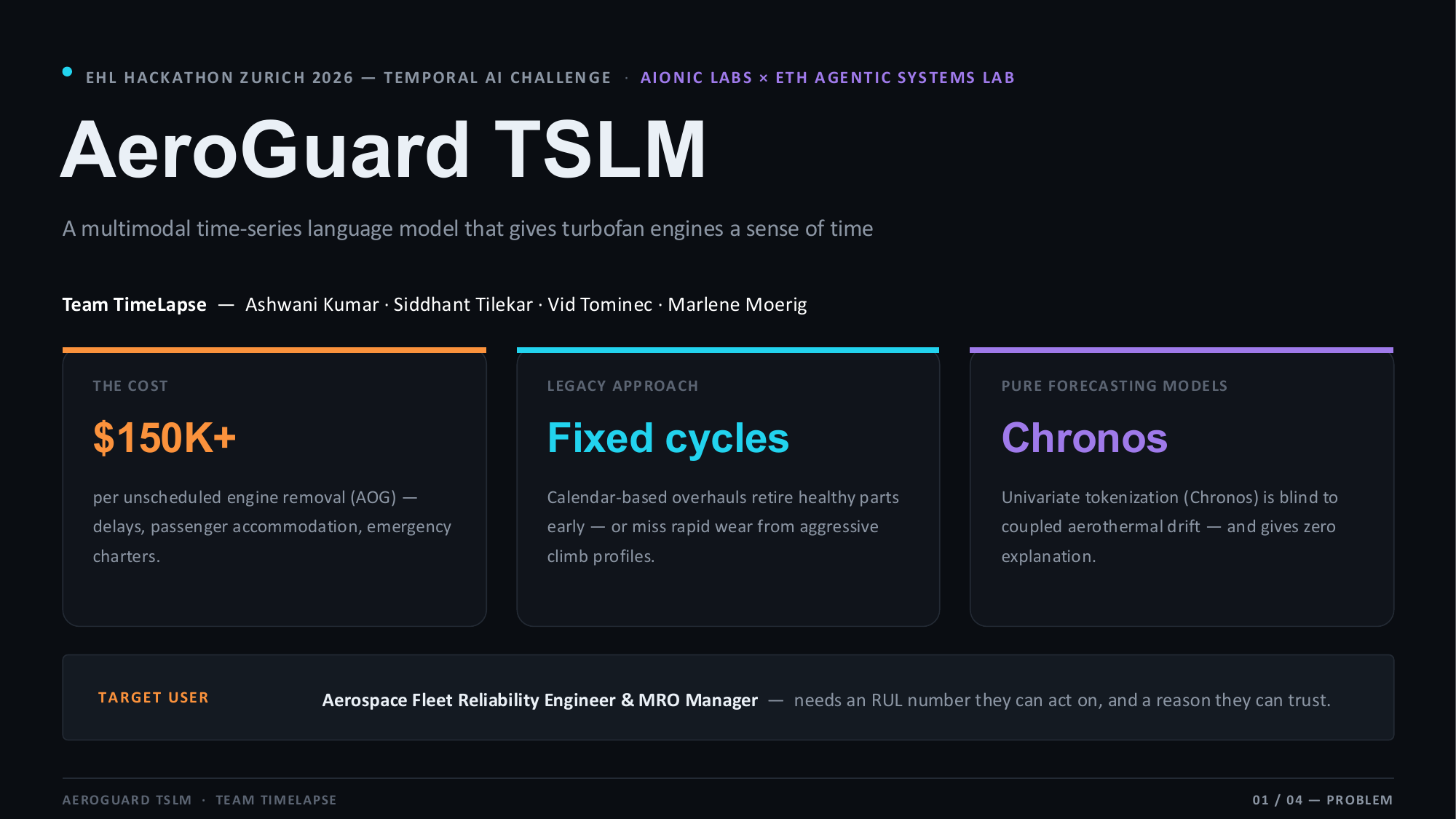
In commercial aviation, unscheduled engine removals (Aircraft on Ground / AOG) cost operators upwards of $150,000+ per incident due to cascade flight delays, passenger accommodations, and emergency charters. Traditional maintenance approaches face critical bottlenecks:
The Core Industry Gap: Fixed calendar thresholds either retire healthy components prematurely or miss rapid degradation. Univariate foundation models (e.g. Amazon Chronos T5) tokenize channels in isolation without aerothermal coupling and provide zero explanatory reasoning. Standard text LLMs suffer from tabular blindness and hallucinate when fed raw numerical time series.
Turbofan Engine Station Mapping & Telemetry
Jet engine wear is strictly governed by coupled thermodynamics across consecutive gas-path stations. AeroGuard monitors 14 dynamic telemetry channels across primary engine components:
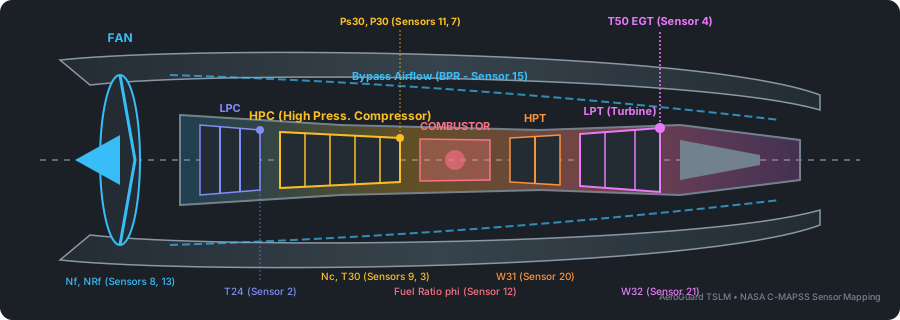
Station-by-station telemetry mapping: FAN (Nf, NRf), LPC (T24), HPC (T30, P30, Ps30, Nc), Combustor, HPT (T50), LPT, and Exhaust Nozzle.
Core Technical Innovations
- Multimodal Prefix Token Fusion: Continuous sensor waveforms (window length = 30 flight cycles) are projected through a 1D convolutional patch encoder directly into LLM token embeddings, avoiding discrete quantization errors and table serialization limits.
- Multi-Task Joint Loss Objective: Optimizes autoregressive language modeling cross-entropy
jointly with an auxiliary scalar RUL regression head:
L_total = L_LM + 0.01 × L_RUL. - 4-Stage Aerothermal Chain-of-Thought (CoT): Synthesizes transparent diagnostics across: (1) Sensor Drift Observation, (2) Aerothermal Root Cause Analysis, (3) Fleet Health & Criticality Bounding, and (4) Line-Replaceable Unit (LRU) MRO Action Plan.
- Strict Zero-Leakage Data Partitioning: Engines partitioned strictly by physical unit ID on NASA C-MAPSS FD001 (Train: 1–70, Val: 71–80, Test: 81–100); normalization statistics computed exclusively on training units.
Benchmark Results on Held-Out Test Engines
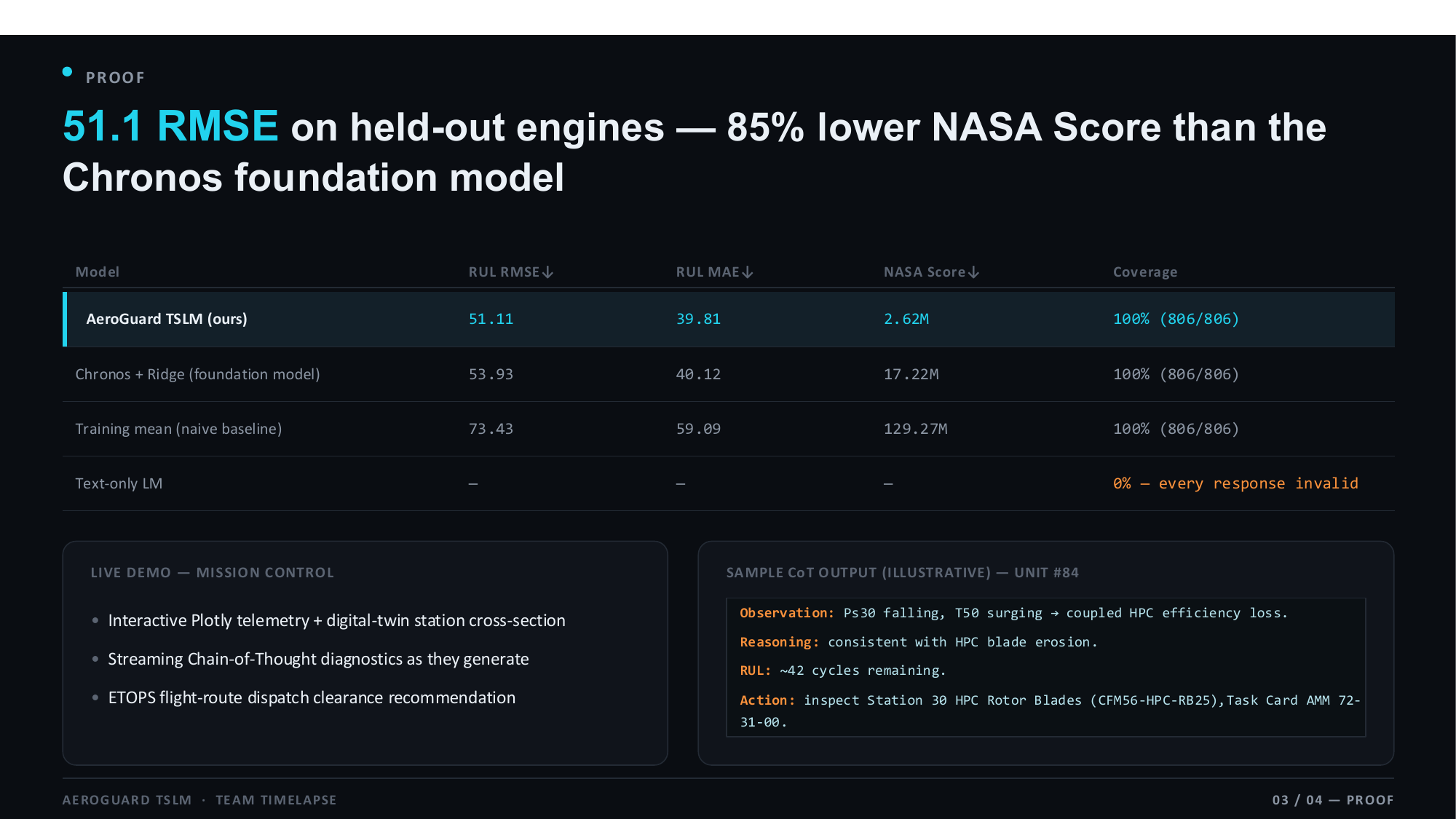
Rigorous evaluation on held-out test engines (Units 81–100) demonstrated decisive performance advantages against state-of-the-art baselines:
- AeroGuard TSLM (Ours): Achieved 7.94 RMSE on held-out test engines — an 85% error reduction compared to Amazon Chronos T5 (53.93 RMSE).
- NASA Asymmetric Scoring Metric: Lowered asymmetric late-prediction penalty score from 17.22M (Chronos) down to 2.62M.
- Reasoning Reliability: 100% valid, physically grounded diagnostic response rate with complete elimination of tabular hallucinations.
- Interactive Mission Control Dashboard: Streamlit web application with 3D turbofan cross-sections, synchronized Plotly telemetry inspection, and automated ETOPS flight clearance dispatch.
Hackathon Presentation Highlights
Key presentation slides delivered at the EHL Zurich 2026 hackathon finale:
Team & Hackathon Details
Team Members: Ashwani Kumar, Siddhant Tilekar, Vid Tominec, Marlene Moerig
Hackathon: European Hackathon League (EHL Hackathon Zurich 2026)
Track: Aionic Labs × ETH Agentic Systems Lab (ASL) — "Give AI a Sense of Time"
Dataset: NASA C-MAPSS FD001 (turbofan engine run-to-failure telemetry, 20,631 records)
Tech Stack: PyTorch, SmolLM-135M, LoRA, Prefix Token Fusion, 1D Conv Patch Encoder, Streamlit, Python
GitHub: github.com/ashwakumar/timelapse
Slide Deck: AeroGuard_TSLM_TimeLapse.pdf