Overview
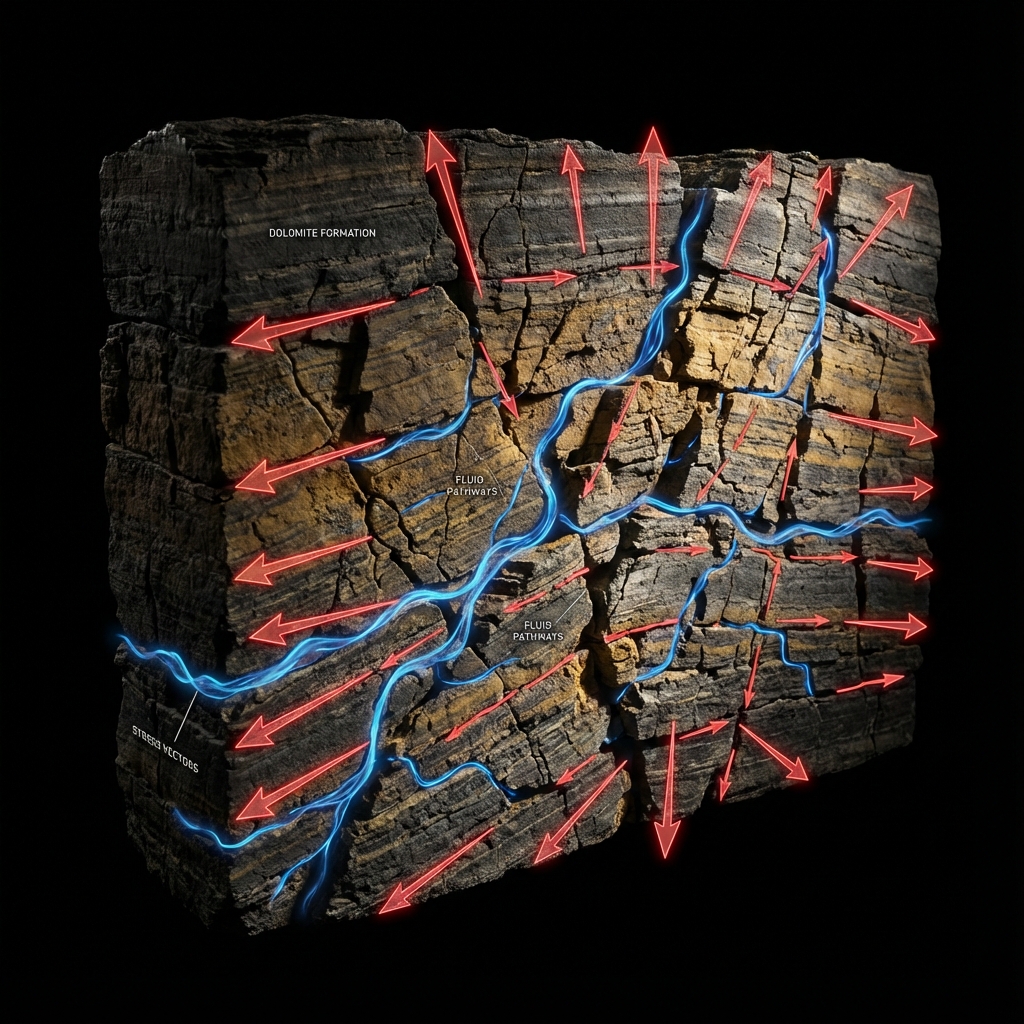
This research investigated how changes in tectonic stress regime affect fracture aperture and permeability in carbonate reservoirs, using the Latemar carbonate buildup in the northern Italian Dolomites as a field analogue.
Combining detailed outcrop data, finite element geomechanical modelling, and fluid flow simulation, it quantifies how stress from multiple tectonic episodes shaped the fracture network and the flow pathways through it.
Problem & motivation
Predicting permeability in fractured carbonates is difficult because fracture networks are highly heterogeneous and strongly influenced by stress history. Previous models typically considered a single stress regime, overlooking the cumulative effect of successive tectonic episodes.
The question: when a rock mass experiences one stress regime and then another, do the effects on permeability cancel, or accumulate? The answer turns out to be neither — they produce new permeability effects that neither regime creates alone.
Contributions
- Developed a three-phase workflow: drone-based outcrop data acquisition, finite element aperture modelling, and single-phase flow simulation.
- Simulated two major tectonic stress regimes — subsidence-related (NW–SE) and Alpine compression (N–S).
- Quantified the effect of stress regime change on fracture aperture distributions and effective permeability tensors.
- Showed permeability increasing by up to 62% under combined tectonic loading versus baseline matrix permeability.
- Demonstrated that fracture density, connectivity, and orientation critically control flow anisotropy.
Method
Field
Drone photogrammetry
Outcrop imaging processed in Agisoft Metashape, with fracture traces mapped in ArcGIS — over 2,000 fractures digitised.
Model
Kratos FEM
2D finite element geomechanical modelling of fracture aperture under applied far-field stress, across five representative fracture substructures.
Upscaling
Homogenisation
Computational homogenisation producing effective permeability tensors, capturing directional anisotropy rather than a single scalar value.
Parameters
Loading
Young's modulus 25 GPa, Poisson's ratio 0.30; applied stresses of 50 MPa (subsidence) and 160 MPa (Alpine compression).
Results
Stress regime changes significantly alter both fracture aperture and permeability anisotropy. Permeability increased by 37–62% depending on the substructure, with stress orientation and fracture density together dictating the dominant flow pathways.
| Loading case | Orientation | Magnitude | Permeability change |
|---|---|---|---|
| Baseline matrix | — | — | reference |
| Subsidence | NW–SE | 50 MPa | increase |
| Alpine compression | N–S | 160 MPa | increase |
| Superimposed | Both | 50 + 160 MPa | +37 to +62% |
The key finding is that superimposed tectonic stresses do not cancel each other out. They instead create permeability effects that neither regime produces on its own, which means single-regime models systematically misestimate flow in rocks with a complex tectonic history.
Impact
These findings improve the ability to predict fluid flow in fractured carbonate reservoirs, with direct implications for hydrocarbon recovery, CO₂ storage, and geothermal energy development — all three depend on knowing where fluid will actually go.
Citation
Contributed the finite element geomechanical modelling and flow simulation.