Overview
Arthroscopically assisted acromioclavicular joint reconstructions involve drilling tunnels through the clavicle and the coracoid process to route a graft. Stress fractures at the coracoid are a known complication and lead to poor clinical outcomes.
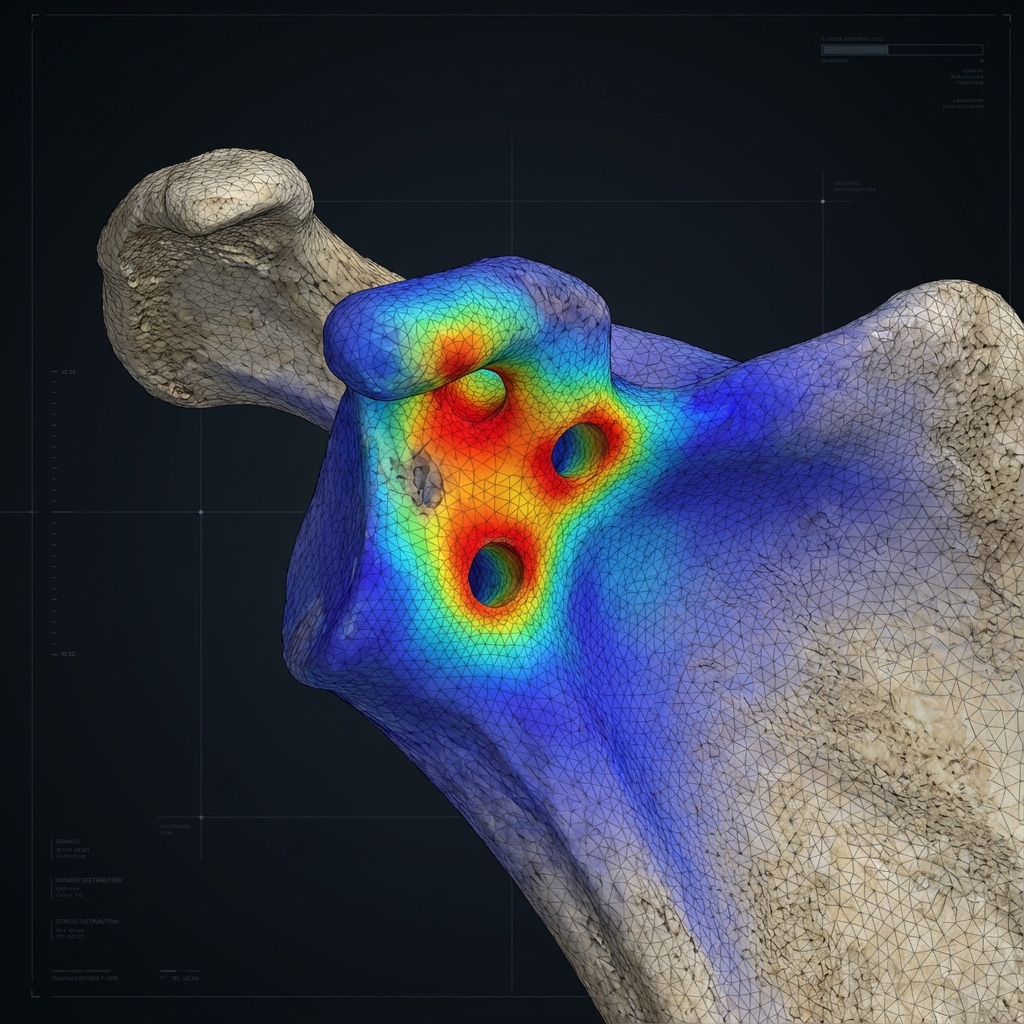
This study investigated how tunnel placement affects shear stress at the coracoid, using a 3D finite element model built from CT imaging alongside a radiological analysis of real surgical cases.
Problem & motivation
Cadaver studies are the conventional way to investigate this question, but they offer limited insight because bone quality varies substantially between specimens — the signal from tunnel placement is swamped by the noise from donor variation.
The approach: a computational model holds bone properties constant, so tunnel geometry is the only variable. Pairing that with radiological review of actual surgeries checks whether the configurations the model favours are the ones surgeons actually achieve.
Contributions
- Built a 3D finite element model of the AC joint from CT imaging with virtual bone tunnels.
- Tested six tunnel configurations for clavicle–coracoid reconstruction.
- Conducted a radiological review of 40 patient cases to validate tunnel placement in real surgeries.
- Identified that a proximal coracoid tunnel with a lateral clavicle tunnel minimised shear stress.
- Showed that certain configurations increased stress by up to 23%, raising fracture risk.
Method
Geometry
CT-based 3D model
Patient CT imaging segmented in 3D Slicer, meshed in GiD, producing 420,793 tetrahedral finite elements.
Solver
Kratos FEM
Von Mises stress evaluation under applied surface loading with Dirichlet boundary conditions at the scapular attachment.
Clinical
Radiological review
Measurement of clavicle drill hole position on post-surgical X-rays across 40 AC joint reconstructions, analysed statistically in SPSS.
Variables
Six configurations
Combinations of proximal/distal coracoid tunnels with lateral/medial clavicle tunnels and traction directions.
Results
Bone tunnel placement strongly influences stress distribution at the coracoid. A lateral traction direction combined with a proximal tunnel significantly lowered stresses; medial or distal placements increased fracture risk, with the worst configuration raising peak stress by 23% over the best.
| Coracoid tunnel | Traction direction | Relative peak shear stress |
|---|---|---|
| Proximal | Lateral | Lowest |
| Proximal | Medial | Elevated |
| Distal | Lateral | Elevated |
| Distal | Medial | +23% |
Impact
The study gives surgeons a concrete, mechanically grounded recommendation for tunnel placement, and demonstrates that computational modelling can resolve questions that cadaver studies cannot answer cleanly. The radiological component confirms the recommendation is achievable in practice, not merely optimal in simulation.
Citation
Contributed the finite element modelling and stress analysis.