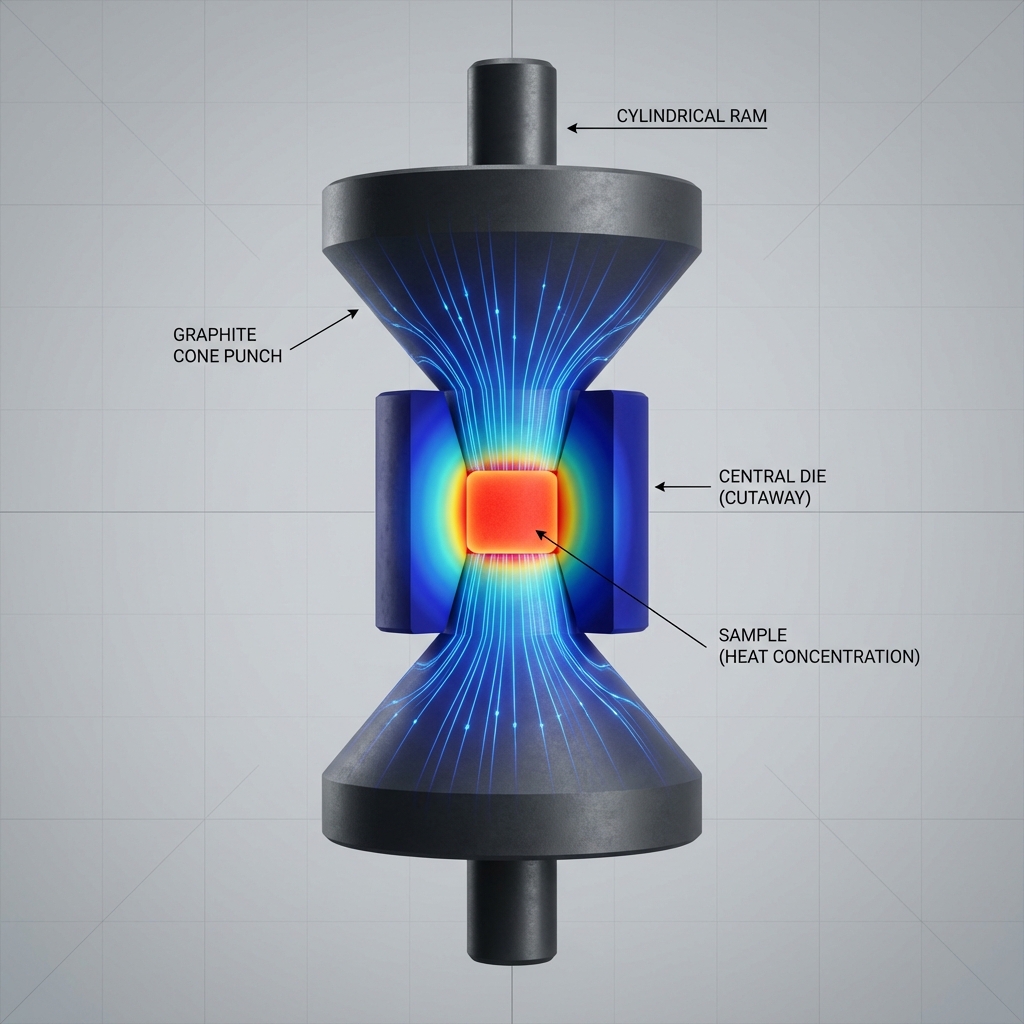
Overview
Every finite element model of spark plasma sintering rests on material data — thermal conductivity, electrical resistivity, creep parameters. In SPS these properties are strongly temperature-dependent, and the temperatures involved make direct measurement during the process impractical.
This project developed a two-stage numerical–experimental framework that identifies them inversely, using COMSOL Multiphysics coupled with genetic algorithm optimisation to fit simulated response to measured response.
Problem & motivation
Traditional calibration for SPS models is often ad-hoc, or assumes constant material properties across the entire temperature range. Both choices introduce significant simulation error, and neither gives any indication of how large that error is.
The insight: electro-thermal behaviour and mechanical behaviour can be calibrated separately. Splitting the identification into two stages makes each inverse problem far better conditioned than solving for all parameters at once.
Contributions
- Developed a two-stage identification strategy separating electro-thermal from mechanical calibration.
- Coupled genetic algorithms with FEM to minimise error between simulated and experimental response.
- Validated identified parameters for graphite (the mould material) and for copper and nickel powders.
- Achieved relative density prediction error below 2.3% for heating rates outside the calibration set.
- Provided a transferable methodology applicable to any conductive powder system in SPS.
Method
Stage 1
Electro-thermal
Identify temperature-dependent electrical resistivity and thermal conductivity by fitting simulated against measured pyrometer temperature histories.
Stage 2
Mechanical
With the thermal field fixed, identify creep parameters — Norton law and Shima–Oyane — by fitting simulated punch displacement against LVDT data.
Optimiser
Genetic algorithm
MATLAB-driven GA search over the parameter space, robust to the non-convex objective landscape typical of inverse thermal problems.
Validation
Held-out heating rates
Parameters identified at one set of heating rates, then tested against experiments at rates never seen during calibration.
Results
The framework enables genuinely predictive modelling of the SPS process, reducing the need for expensive experimental trial-and-error. Because it captures the temperature-dependent evolution of material properties rather than assuming constants, the model predicts final density and shape with high fidelity.
The held-out validation matters more than the fit quality: a model that reproduces its own calibration data proves nothing. Predicting density to within 2.3% at heating rates outside the training set is what makes the identified parameters trustworthy for optimising sintering cycles on new materials.
Impact
This work provides the material data foundation that the later Direct FE² multiscale framework and the multi-material interface model both build on. The two-stage strategy has since been reused to calibrate new powder systems with roughly half the experimental campaign previously required.