Overview
Multi-material SPS makes it possible to build architected components with properties that vary through the part — hard where it needs to resist wear, conductive where it needs to carry current. The problem is that dissimilar materials densify at different rates, so the interface between them moves during sintering, and the finished geometry is not the geometry you designed.
This project introduced a validated fully coupled electro-thermo-mechanical model for Cu–Ni systems that reproduces this behaviour accurately enough to be used as a design tool rather than a post-hoc explanation.
Problem & motivation
Differential densification and interface misalignment are the two failure modes that limit multi-material SPS. Experimental trial-and-error cannot easily separate the contributions of current flow, localised heating, and stress at the interface, because all three act simultaneously and none is directly observable inside a hot die.
What was needed: a predictive multiphysics model, validated against experiment, that could explain the coupled phenomena at the interface and guide powder deposition and interface orientation before the first sample is pressed.
Contributions
- Developed a fully coupled FE model integrating electrical, thermal, and mechanical interactions for Cu–Ni SPS.
- Demonstrated that porosity-dependent constitutive parameters identified from single-material SPS transfer directly to multi-material systems — no recalibration required.
- Achieved less than 1% deviation between simulated and experimental temperature and densification data.
- Revealed that porosity imbalance drives interface displacement, providing a direct design lever for geometric precision.
Method
Solver
COMSOL Multiphysics
Electro-thermal–mechanical finite element analysis with fully coupled field solution rather than sequential staggering.
Material
Sintering law
Porosity-dependent constitutive models for copper and nickel powders, with parameters carried over from single-material calibration.
Validation
Experimental SPS
Measured temperature histories and densification kinetics from a physical SPS setup, compared directly against predicted curves.
Output
Interface tracking
Final interface position and part geometry predicted as a function of initial porosity distribution and interface orientation.
Results
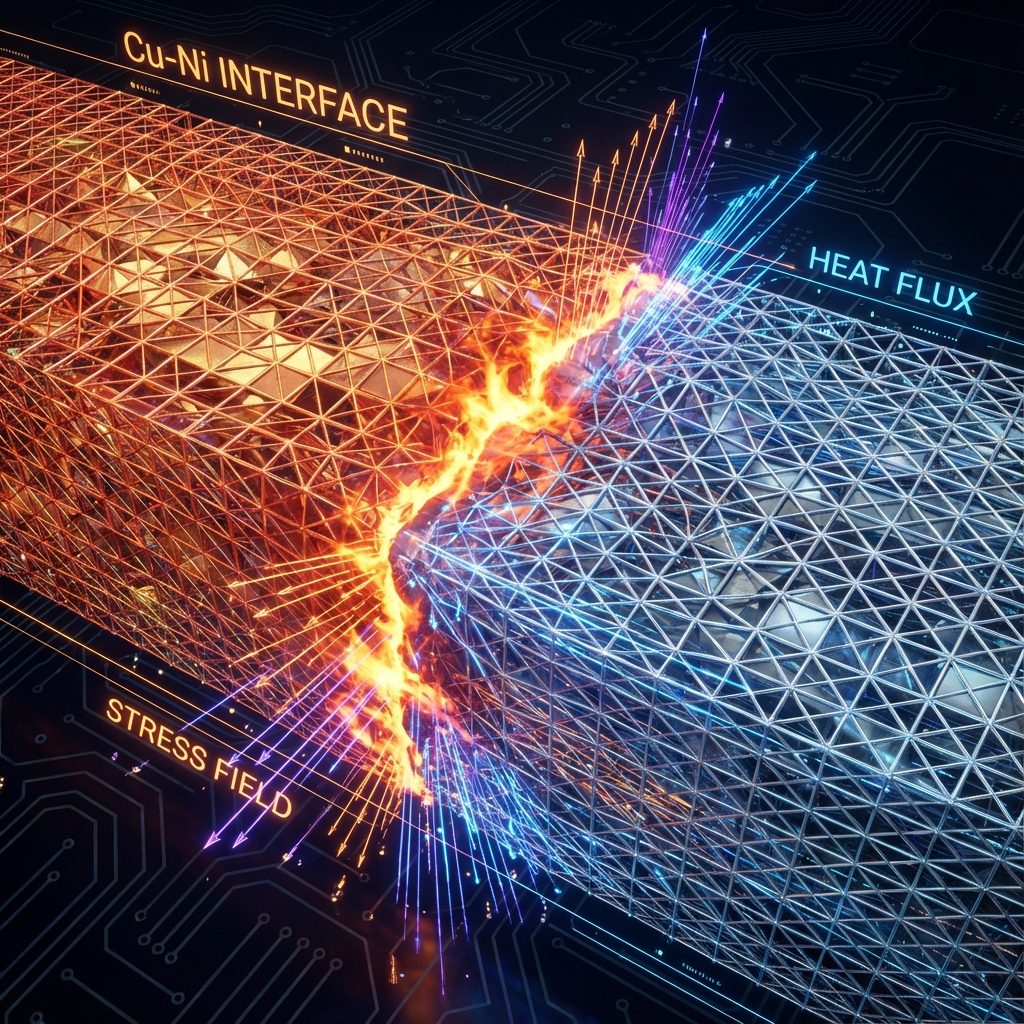
The validated model precisely reproduced temperature histories and densification kinetics, confirming strong predictive capability. More usefully, the simulations exposed the causal chain: interface geometry dictates current redistribution, current redistribution drives localised heating, and localised heating produces the final interface displacement.
Because that chain is now explicit, adjusting the initial porosity and interface alignment allows targeted control of post-sintering geometry — the part comes out the shape you intended.
Impact
This framework provides design-level insight that extends beyond what experiments can reach, enabling optimisation of powder deposition and interface design for advanced multi-material manufacturing. The transferability of single-material parameters is the practical result: it means the calibration effort for a new material pairing is roughly half what it would otherwise be.
Citation
Currently under review. This page will be updated with the DOI on publication.