Project Overview
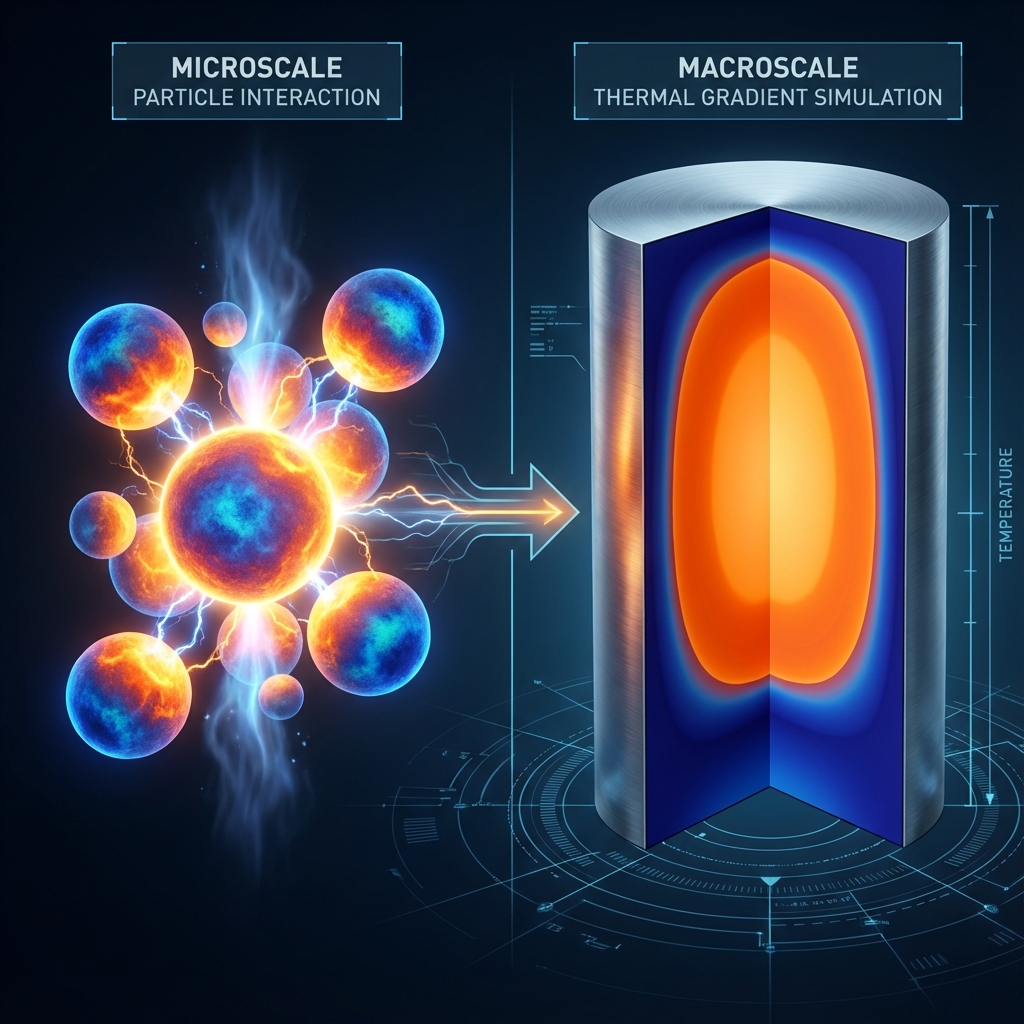
This project focuses on improving the simulation of spark plasma sintering (SPS), a key process in advanced materials manufacturing. Traditional finite element models either miss microscale powder interactions or become too computationally expensive. To address this, a Direct FE² multiscale framework was developed that directly integrates microscale powder behavior into macroscale electro-thermal-mechanical simulations.
Problem & Motivation
SPS involves complex electrical, thermal, and mechanical interactions across different scales. Existing models either treat powder as a continuum (ignoring particle-level detail) or use particle-based methods (accurate but computationally prohibitive). This gap made it difficult to simulate large-scale SPS with both accuracy and efficiency.
The gap: continuum models ignore particle-level detail; particle-based methods are accurate but computationally intractable at component scale. Neither could simulate large-scale SPS with both accuracy and efficiency.
Research Contributions
- Designed a Direct FE² approach for fully coupled electro-thermal-mechanical SPS simulations.
- Achieved temperature & displacement error below 1% compared to full FE analysis.
- Reduced computational cost by factors up to 70×, with degrees of freedom reduced up to 44×.
- Demonstrated flexibility in handling different powder morphologies (SC, BCC, FCC).
- Validated the model against the Heckel equation.
Technical Highlights
- Tools & Platforms: Abaqus FE solver, Python scripting for automation.
- Methods: Finite Element Analysis (FEA), multiscale FE² coupling, representative volume elements (RVEs), periodic boundary conditions, multi-point constraints.
- Models Used: Coupled electro-thermal-mechanical FE models, Johnson–Cook material law for copper powders.
- Performance: Demonstrated scalable efficiency with 8–70× faster runtime compared to full FE methods.
Results & Impact
The Direct FE² framework produced results nearly identical to full FE simulations while drastically lowering computational cost. It revealed how powder morphology, mesh scaling, and current intensity affect densification during SPS. The method makes it feasible to simulate realistic SPS geometries that were previously computationally intractable. This work advances multiscale modeling in materials processing and provides a foundation for future studies on non-spherical powders and complex geometries.